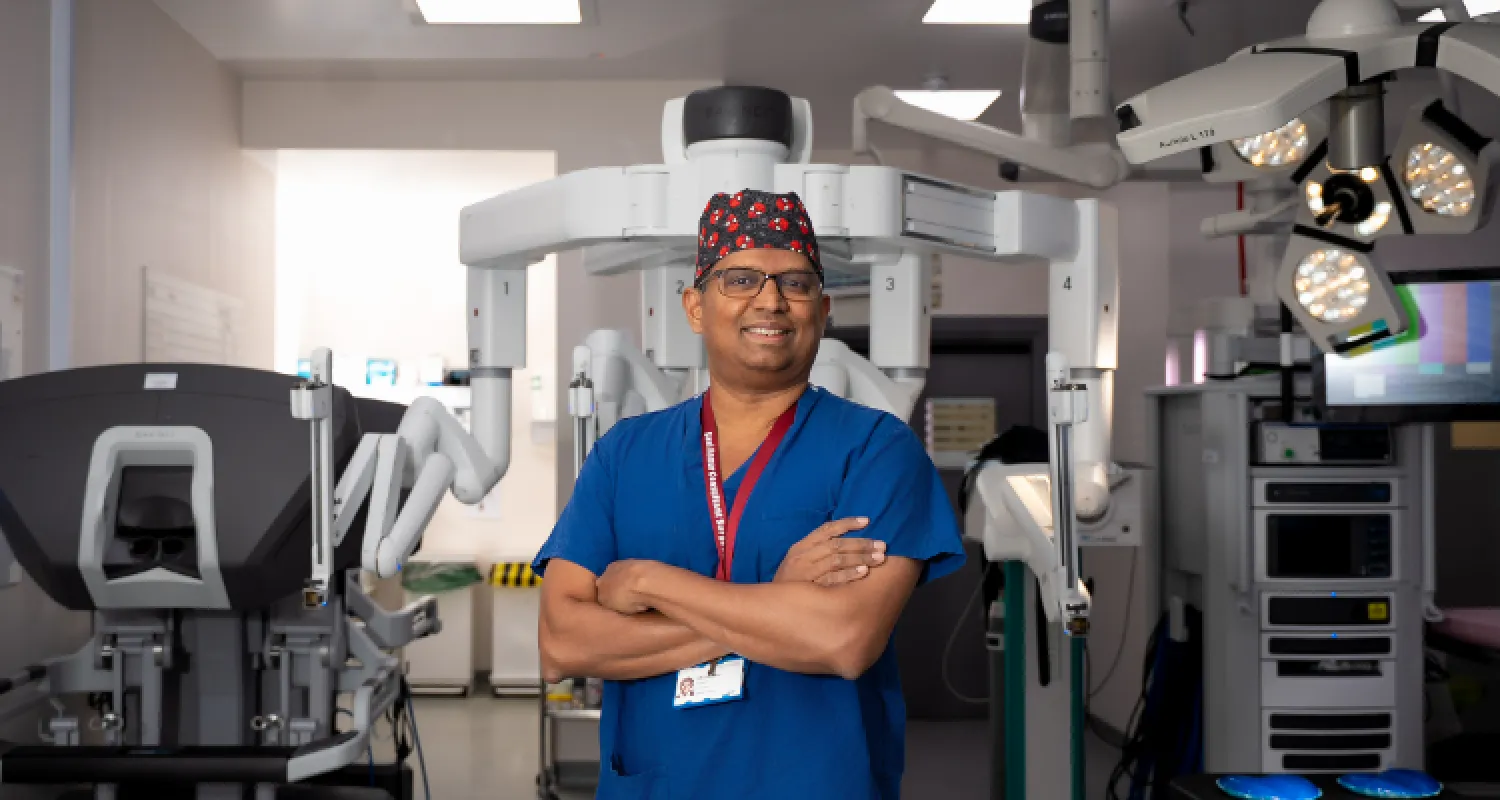
King’s College Hospital is leading the way in surgical innovation, with surgeons achieving a major milestone in patient care. Following the introduction of robotic-assisted surgery just over two years ago, this advanced technology has helped more patients receive treatment sooner and recover more quickly than with open or laparoscopic (keyhole) surgery.
Since May 2023, when the £1.9 million Da Vinci Xi Robot Assisted Surgical (RAS) system was introduced at King’s, the technology has transformed care for patients with cancer and many other conditions. Funded in large part by a £1 million grant from King’s College Hospital Charity, the robotic system allows surgeons to perform delicate operations with exceptional precision and control.
Mr Sasindran Ramar, Consultant Bariatric, Metabolic and General Surgeon at King’s, said:
He explains that, since adopting robotic technology, he has been able to treat twice as many patients in the same amount of time, helping to ease pressure on waiting lists.
How robotic surgery is changing care at King’s
Robotic-assisted procedures have transformed patient care at King’s for people living with a wide range of conditions, including cancer and complex endometriosis.
This technology is especially important for patients who are frail or living with multiple health conditions, for whom traditional surgery may be considered unsafe. The robotic system helps to reduce the risk of complications, making surgery a safer option for more people.
What this means for patients
For many patients, robotic surgery has been life-changing. By supporting safer, less invasive procedures, this technology helps people return to everyday life sooner. One urology patient described how his recovery following robotic surgery meant he was able to spend precious time with his newborn baby far sooner than expected.
Mr Amyn Haji, Clinical Director in Surgery at King’s and Chair of the Robotic Surgery Programme, said:
“Performing our 1,000th robotic surgery is a significant achievement. Patients have benefitted from better outcomes, fewer complications and shorter hospital stays. We now hope to expand access so that even more people can benefit from this world-leading technology.”
How the Charity supports transformation
Iona Joy, Director of Grants and Insight at King’s College Hospital Charity, said:
Contributing to state-of-the-art equipment like the surgical robot is one of the ways King’s College Hospital Charity helps transform care, supporting clinicians to deliver outstanding outcomes that go beyond what the NHS could provide alone.