Two years ago, at just 34 years old, Lewis started noticing mild symptoms on his face and skin. He called his GP for advice and kept monitoring his symptoms.
However, as months passed by Lewis's symptoms were getting worse, his muscles were feeling tighter and weaker, and he was feeling a lot more fatigued.
After visiting a chiropractor and consulting his GP again, Lewis had a blood test at his local hospital. The results were alarming—he had nearly four times the normal amount of cortisol in his body. He was treated at his local hospital, where doctors eventually discovered an extremely large cancerous tumour on one of his adrenal glands.
Lewis was referred to another hospital trust where it was revealed the tumour had spread to his liver. Doctors found a lung nodule and discovered that the tumour was now pressing against one of his kidneys.
After some time, Lewis was told, heartbreakingly, that the surgery couldn't go ahead and he was now terminal.

After processing this devastating news, Lewis was referred to King's and met with Consultant Surgeon Mr Srinivasan, where Lewis was told: "I've got you, don't worry."
The surgery lasted for around seven hours, with Lewis waking up in an intensive care ward. The operation went as well as it could have and the whole tumour on the adrenal gland was removed. As the tumour had joined to a kidney, this meant that sadly one had to be removed.
We originally spoke to Lewis in January 2025, below is his King's story:
King's recently caught up with Lewis for an update:
After his surgery, Lewis had a small cluster and one separate nodule on his liver. He had Selective Internal Radiation Therapy (SIRT) to treat the small cluster and due to his results was given the green light to have the same type of this radiotherapy again.
The team at King's made the decision to give Lewis two rounds of SIRT because his cancer had spread from the adrenal gland to his liver. Giving this type of treatment twice is extremely rare, as the standard treatment is one round and the team at King's believe it has never been done in the UK before.
The nodule on Lewis's liver was also treated. In April, Lewis received a phone call and was told the fantastic news that both treatments had fully worked and that he was in remission for the first time since his diagnosis in October 2022.

While in remission, King's monitored Lewis closely. Sadly, Lewis's cancer came back in early 2026. A set of scans showed there was a tumour on his left adrenal gland, but it was unclear if it was malignant or benign. If the bronchoscopy sample and the adrenal gland tumour were both cancerous, Lewis would need to go through chemotherapy again.
Around this time of having discussions about his adrenal gland (the aggressive tumour had now grown to around 25mm), Lewis found out he had developed another small nodule, this time on his left lung. The priority was to deal with the adrenal gland first via surgery.
The surgery was a success. However, after the surgery, the doctors found Lewis slipping in and out of consciousness and discovered he had lost four pints of blood due to a damaged capillary that was behind an organ. During his stay at King's, it was confirmed that the tumour was cancerous.
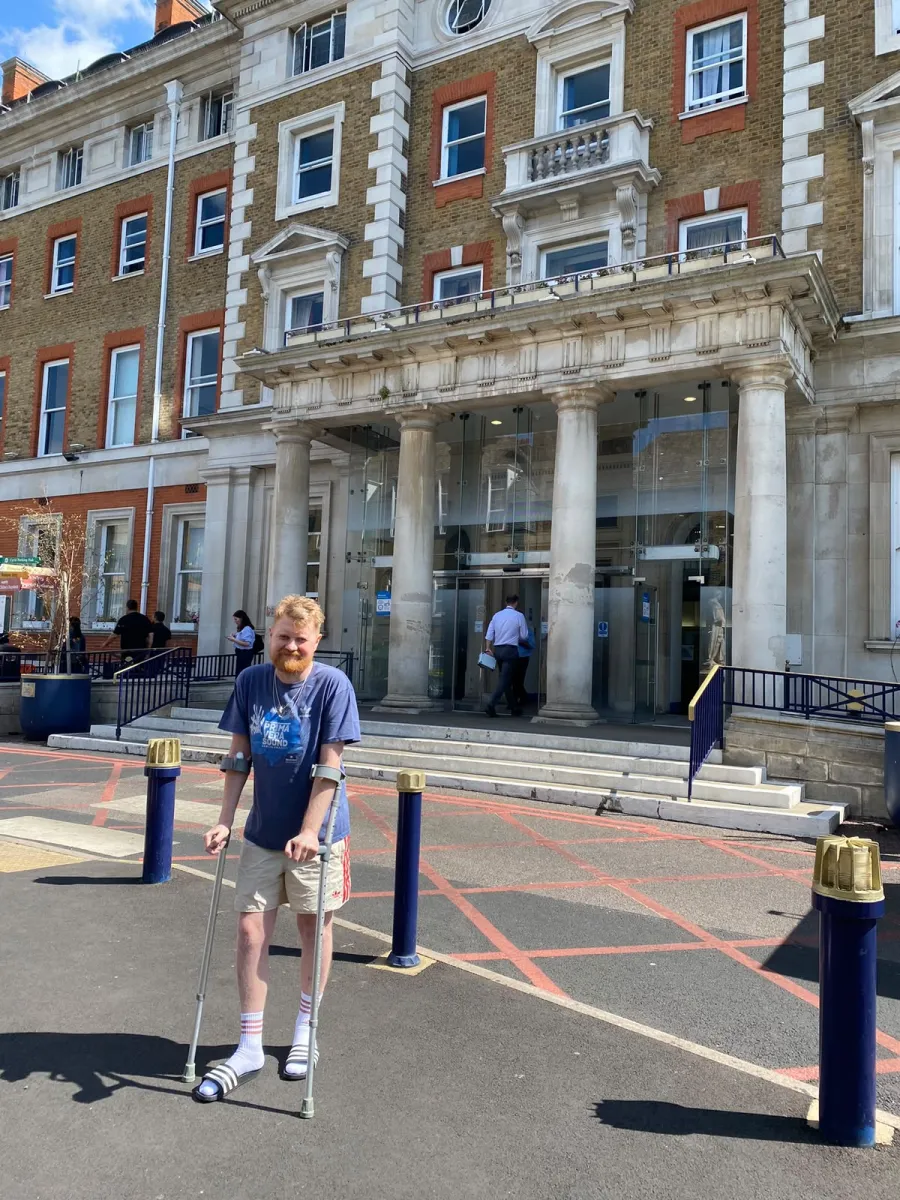
Lewis had some further complications. He had fallen into adrenal crisis, due to both of his adrenal glands being removed, which meant being rushed back into hospital. After being moved to the general ward and having 30 stitches removed, Lewis was discharged for the final time on 31 July 2026.
Lewis is now closer to being cancer-free once again, with the small lung nodule being the only concern at the moment. With both of his adrenal glands removed, his body doesn’t produce the adequate cortisol needed and therefore will be on steroids for the rest of his life, alongside living with Addison's disease.
Lewis said:
"I would to say a massive thank you to Dr Whitelaw, my endocrinologist who has overseen my cancer journey and managed to get me into the position I am in today. Along with the help of my hero Mr Srinivasan (liver surgeon) - the surgeon who started it all, Dr Sarkar (oncologist), Dr Galata (adrenal surgeon), the radiologist team and all of the nurses involved, as well as to the other 30 people I can't remember.
Last but not least, to my family and especially to my partner Michelle. I am simply blown away by King's and Guy's. These hospitals have not given up on me and I cannot put it into words what it means, or thank them enough. The amount of people investing their time to save my life I will never ever forget and will forever feel indebted to."
We at King's College Hospital Charity wish Lewis all the very best in his recovery.
Lewis received support from Cancer Lads, a support group for men with cancer.